Thursday, April 4, 2013

"The Butterfly's Ball"


The Butterfly's Ball Poem
On the smooth-shaven grass by the side of the wood,
Beneath a broad oak that for ages has stood,
See the children of earth, and the tenants of air,
For an evening's amusement together repair.

And there came the Beetle, so blind, and so black,
Who carried the Emmet, his friend, on his back;
And there came the Gnat, and the Dragonfly too,
And all their relations, green, orange, and blue.

And there came the Moth, with her plumage of down,
And the Hornet, with jacket of yellow and brown,
Who with him, the Wasp, his companion did bring;
They promised the evening to lay by their sting.

Then the sly little Dormouse peep'd out of his hole,
And let to the feast his blind cousin the Mole;
And the Snail, with her horns peeping out from her shell,
Came fatigued with the distance, the length of an ell.

A Mushroom the table, and on it were spread
A Water-dock-leaf, which their table-cloth made,
The viands were various, to each of their taste,
And the Bee brought the honey to sweeten the feast.

With steps more majestic that Snail did advance,
And he promised the gazers a minuet dance;
But they all laughed so loudly he pull'd in his head,
And went, in his own little chamber, to bed.

Then as evening gave way to the shadows of night,
Their watchman, the Glow-worm, came out with his light;
So home let us hasten, while yet we can see,
For no watchman is waiting for you or for me.

Color A Celtic Resurrection Butterfly Cross

       I used metallic ink pens to color in my teacher's sample cross drawing. These inks really stand out if you draw with them on dark or black construction paper. Although, I chose to draw on a nice acid free paper for this particular activity (construction paper fades rapidly). The project is designed for students fourth grade and up. I've included patterns for the butterfly and cross below for those of you who would like to draw a cross very similar to mine. I colored the floral part of my design with Rembrandt colored pencils. These have a nice velvety texture that sharply compliments the metallic inks.
      The butterfly in the modern Christian church, and when I say modern I mean within the last 100 years, is used as a symbol for resurrection. This is because the metamorphosis that takes place during the life cycle of butterflies mirrors the lives of regenerated Christians in both life and death after the Holy Spirit indwells them personally. The cross, in turn, symbolizes the beginning of this resurrection process because of the ultimate price of salvation paid for us through Christ's death on the cross and His resurrection from the tomb.
      Encourage your students to frame their work if they are pleased with the results. I have found that many parents love to receive simple drawings such as these for a birthday or Mother's Day and/or Father's Day gift.
This is my teacher's sample of a Resurrection Butterfly Cross.
Students can use all kinds of metallic ink pens to color in their
 sketches. They will need to use a white or yellow colored pencil
to trace around their stencils before applying the inks. Although I
chose silver for my sample, this pattern would look just as
 attractive in gold or copper inks.

Click directly on the image to download the largest possible file.
 You will need to
fold an additional piece of paper and
place the dotted lines of the cross template on top
 of the fold to cut out the entire cross pattern.

More Links to Cross Drawing/Coloring Projects:

Thursday, March 28, 2013

Craft An Empty Tomb Easter Egg

The finished empty tomb Easter egg, front and side.

    I crafted this empty tomb Easter egg with air dry clay, a half shaped, Styrofoam egg and paint.      The egg form also has a hollow interior and I will post a photo of what these look like just as soon as I can take a picture. 
      For those of you who may be a bit intimidated by shaping your own stones from clay, there are shallow molds for sale in craft and hobby shops for the very purpose of crafting stone walls. The results are so nice that the purchase of one of these is an excellent investment. 
      After pressing the air dry clay into a mold, (shown below) simply adhere the printed clay to the Styrofoam egg with tacky white glue. You will then need to continue working while your clay is still wet. Use a toothpick or a fork and work the clay surface a bit by pushing deeper crevices between the stones to create a more three-dimensional stone wall surface.      I let my stone tomb egg dry over night then I painted it's interior with black acrylic paint. Next, I painted the exterior stones with shades of grey and pale browns. Being satisfied with my final results, I then pasted a cross shaped sticker to the interior of the egg shaped tomb and gave my entire Easter egg a coat of acrylic varnish.

Craft stained glass windows from melted crayons

      Remember melting crayons to create beautiful stained glass window art when you were a kid? My Sunday School teacher did this in class with us many years ago. We would shave crayons with small hand-held pencil sharpeners onto white tissue paper. Then our teachers would carefully cover our tissue and shavings with wax paper and carry the layers over to an ironing board and melt them by rubbing a hot iron over the surface of the wax paper. 
      You can actually achieve the same melted effect by using a hair dryer if you wish. I also remove the wax paper after it has cooled. This only takes seconds to accomplish and then all you need to do is cut a black template from construction paper in order to frame your melted master piece.
      This craft needs adult supervision and patience. I've used some stained glass window frames for my teaching samples that are a bit complex. Design stencils for window frames that are simpler if your students are younger.  Have the children cut out the frames before shaving and melting crayons from black construction paper if they are older than nine. 
       Since I've published this craft here, designs at Color The Bible have been uploaded for coloring pages. These can easily be adapted for pattern making of stained glass windows.

Above you can see that a small hand-held pencil sharpener is quite adequate for shaving crayons. Remove the paper first and don't use too many dark colors for your mix, otherwise, the results can turn a bit muddy. I used the original cut templates for my teacher's sample so that I wouldn't need to cut my stencils twice. After this I then created a template from the sample that could be printed out in black and white so that my students only needed to cut out the center of the design.

Just left, you can see the stained glass window taped onto an actual window. The colors a very brilliant. I have limited my color choices to reds, oranges and yellows in order to emphasize a monochromatic palette. You may wish to teach students about color mixing or the color wheel during this lesson by requiring young students shave together particular color combinations.

More Examples of Melted Crayon Crafts:

Wednesday, March 27, 2013

Drawing Butterflies By Progressive Steps

     I have included here a series of five, butterfly, drawing exercises from an old book. In each case it is the last figure of each series of diagrams that you are striving to copy.
      Learning to draw is best when students are encouraged by multiple means of processing information. Teachers should encourage progressive diagram drawing, drawing from real life, drawing from artworks and from their imaginations. The more articulate the student, the easier it becomes for him or her to express themselves. It is difficult for art students to become articulate if their teacher is attaching too much philosophy to practice early in their pupil's development.
      Each method of drawing accesses different areas of the brain. Educators will soon discover that different students excel at different rates according to their familiarity with utilizing that particular part of their brain. Teaching art to the very young should focus primarily on the absorption of knowledge and how to use it within a wide variety of circumstance/context. 
      All artists should be given time to learn how to manipulate information without having the process judged by those art educators that teach according to current popular belief.  Do not fixate on artistic schools of thought or practice until a student is approximately sixteen or older and is able to make important choices for himself apart from your personal tastes and opinions.
      The method of drawing illustrated in the jpgs. below, is very appropriate for cartoonists or graphic designers to learn. Encourage art students to try this method of making art along with many other practices inside your classroom.
full frontal butterfly draw

Draw butterfly from side.

Draw another butterfly from side.
Smaller butterfly drawing challenge.

Last step-by-step butterfly drawing challenge.

Monday, March 25, 2013

How To Decoupage a Picture On To An Easter Egg

Here is an obvious question. "How do you decoupage a picture
or a scene onto an egg?" Obvious question, rarely answered.
Above you see a sweet example of this from a manufacturer
of Easter novelty.


Supply List:
  • smallish dinner napkins in a pattern you would like to see on your Easter egg.
  • egg (can be plastic or real)
  • Mod Podge
  • hot glue gun and hot glue to attach a ribbon on top of the egg
Step-by-Step Instructions:

  1. Gently separate the layers of your dinner napkin. You will only be working with the printed one on top.
  2. Measure the length of your egg and cut rectangular strip from the napkin or tissue paper to fit neatly around it. 
  3. Now you will need to cut at regular intervals, slashes into your design. Notice how I do NOT cut all the way through the rectangle. (pictured below) I leave about an inch uncut. This uncut central part of the rectangle is the continuous, uninterrupted part of the design that wraps around the mid section of the egg. The larger your egg the wider this section will be. 
  4. After cutting this napkin thus, apply Mod Podge to the surface of your egg and carefully paste down the napkin, starting first with the middle part of the design. The fringed parts of the napkin will overlap some but the design should be preserved for the most part. 
  5. After cutting and gluing this first piece of the napkin, I then cut out parts of the design that I thought the most attractive from left over napkins and pasted these on the top and bottom parts of my egg where the design did not cover. This is because I used very large eggs for this project and my napkins were quite small and the wider, bottom half of my egg needed additional decoupage to cover it completely. 
  6. In order for your eggs to look professional, you need to use very thin tissues for this project. This insures that the design will appear uninterrupted and hand painted. 
  7. Also, I was very particular about the colors of eggs that I used for the design. Had I used dark blue or purple plastic eggs, this design would not be as attractive. The napkin is very thin and the colors will show through the glue and tissue, so be selective. The factory made egg above was yellow. The one below that I covered was pink.
  8. After the egg has dried completely give it a final coat of Mod Podge.
  9. Hot glue an attractive ribbon to the top of the egg if you wish to hang it.

See finished eggs with fancy pink dinner napkin decoupaged
on the plastic surfaces. You can use the same process on 
real eggs too!

Left, peal off the solid layers of napkin on the bottom; you won't need to include them in the 
process. Center, the napkin cut with fringe across the top and bottom. Right, different eggs, same
dinner napkin cut apart to give a alternative look.

See different applications of the same napkin design.

Decoupage Easter Eggs:

Free Vintage Patterns for Easter Eggs

Painting patterns from left to right in order: An Old-Fashioned Calico Egg,
A Design Taken From Bright Ribbons, Czechoslovakia flowers in bright colors,
A row of yellow ducks on a batik egg and flowers/bow-knots from an old silk.

      Above are very old illustrated patterns for painting eggs, below are vintage patterns for sewing eggs and carrots. The egg templates include five sizes. 
       Select the size you prefer and then make a cardboard template by tracing around the size selected. 
       Cut four copies from fabric to sew together for one egg. A 1/4 seam allowance is included with the template. 
       I suggest sewing the eggs by hand instead of on the machine because the seams are so very narrow.
       After leaving an opening of one and a half inch, turn the egg right sides out and stuff tightly. Close the opening with an invisible stitch and then apply trims and fancy embroidery.
5 egg sizes. See two sizes made up in bumble bee flannel fabric at colorthebible.blogspot.com.
 
       To make fabric carrots, select the size, cut it out and trace around for the cardboard template. Cut just one triangle from orange fabric. Fold in half, sew down the side and turn right side out. Stuff with cotton filling up to the top of the carrot. 
       Sew a straight stitch around the top opening to gather it shut. Then attach a green ruffled ribbon or ruffled felt around the top gathered edges to cover and mimic the greens on top. You could also attach green lace alternatively for a folksy looking carrot.
 
See my vintage veggies in red-orange velvet with tassel tops;
 these are made with the simple pattern below.


3 carrot sizes

Thursday, March 21, 2013

Very Vintage Easter Egg Designs


      This little violet dyed, Easter egg is perhaps the oldest egg I hang on my Easter tree. It was made sometime in the 1940s or 30s. My mother-in-law hung it on her childhood Easter tree. I think the lavender food dye has lasted far longer than anyone could ever had anticipated. The violets are made from molded velveteen.

Just Lilla shows how to make ribbon violets.
 
Enamel Easter egg containers are still as popular as they were 100 years ago!

       In the collection illustrated above at the far left on top is a vintage aluminum egg that opens to reveal a secret message and perhaps a chocolate too. It was made almost 100 years ago and belonged to my mother-in-law. The larger eggs are reproductions only manufactured within the past twenty years. I filled them with jelly beans and other sweets for our daughters to discover on Easter morning among other toys inside of their baskets.

    A Decorative Bird Box

          I love these little bird boxes by Martha Stewart. I plan to stuff mine with a few Easter treats this year, but these little tweets would be just as sweet to decorate for any festive occasion. The bird boxes come three to a package so I will show you three different ways to decorate them. This first example is perhaps the easiest. 
          First, I painted a thin layer of acrylic varnish all over the surface of my bird box and let it dry over night. Then I used a fine line, permanent, black ink marker to draw swirls and curls emphasizing the raised portions of the bird's wings etc... Afterwards, I coated the box again with a second layer of acrylic varnish.


    Wednesday, March 20, 2013

    Pin The Ears On The Rabbit

    Pin the ears on the rabbit.
          Print out the pictures on which is the earless rabbit and his ears are drawn (below). Hang the earless rabbit on the wall, as shown by the sketch, right. Then cut out the ears included in this post and stick a pin through the little holes marked "Pin."
          Now you are ready to play the game. Blindfold a boy or girl and put one of the ears in his or her hand. Turn the blindfolded one around three times, stopping with face turned to the rabbit. Then let the player step forward and try to pin the ear in the right place.
          All sorts of fun comes from the funny mistakes of the players.
          You can get better results by mounting the rabbit panel and the ears on cardboard.

    More Rabbit Themed Games:


    Printables for the game here.

    Anna's Easter Dream by Louise Cooper

    When little Anna went to sleep
    Upon the eve of Easter day
    She dreamed of candied eggs a heap
    And frisky, brisky lambs at play.
    Plump Humpty Dumpty, with a bow,
    Stood smiling on the counterpane,
    And Ducky Daddles, wondering how,
    Was at the foot just to explain.
    Three baby ducks in noisy play,
    Who never thought to pardon beg.
    Cried "Quack, quack, quack for Easter day!"
    And then tobogganed down an egg.
    A rooster and a hen on nest
    Exclaimed, "Please put us in the rhyme,
    for we are doing our level best
    In working up the Easter time!"
    five bunnies, each with eyes of pink
    And ears so long they flapped like wings,
    Said, "We are not considered bad.
    And, don't forget, we're little too."
    five sparrows, proud of their wee size--
    They never grow too broad or tall--
    Chirped, "We should surely win a prize,
    for we are littlest of them all."
    Two tiny men from Titakum,
    With good strong arm and sturdy leg,
    Held steady as a block o fgum
    A large and glowing rainbow egg:
    There, standing on it like a queen.
    With rosy lips and roguish eye.
    In pink and gold and bronze and green,
    The girly, curly butterfly.

    by Louise Cooper

    Tuesday, March 19, 2013

    Easter Eggs That Imitate Wedgwood Blue Earthenware

    Typical wedgwood blue
    plate with white decor
          I have always been in love with Wedgwood blue earthenware. It is very expensive, however, so it is not likely that I will ever acquire much of it. I did find some "Wedgewood" look-alikes  in a hobby shop many years ago and adhered these medallions to Styrofoam eggs. Then, I covered the back half of my eggs with blue paint, glitter and some vintage lace. I strung my blue, "Wedgwood"eggs on glass bead hangers. These eggs are my favorites and I hang them on one of my Easter egg trees every year.
          In 1765, Wedgwood created a new earthenware form which impressed the then British Queen consort Charlotte of Mecklenburg-Strelitz who gave permission to call it "Queen's Ware"; this new form sold extremely well across Europe. The following year Wedgwood bought Etruria, a large Staffordshire estate, as both home and factory site. Wedgwood developed a number of further industrial innovations for his company, notably a way of measuring kiln temperatures accurately and new ware types Black Basalt and Jasper Ware. Wedgwood's most famous ware is jasperware. It was created to look like ancient cameo glass. It was inspired by the Portland Vase, a Roman vessel which is now a museum piece.. (The first jasperware colour was Portland Blue, an innovation that required experiments with more than 3,000 samples). In recognition of the importance of his pyrometric beads (pyrometer), Josiah Wedgwood was elected a member of the Royal Society in 1783. Today, the Wedgwood Prestige collection sells replicas of some of the original designs as well as modern neo-classical style jasperware. Read more . . .

    Easter eggs featuring Wedgewood look-alike medallions. Push the medallions gently
     into the foam egg before gluing these in place with a tacky white glue.


    My family has visited here during the summer months.
    This makes for a relaxed, family friendly trip.

    Craft a Humpty-Dumpty Easter Egg


    The Humpty egg from different view points.

           This Humpty-Dumpty Easter egg is much easier to make than he looks. I used a small face mold and a bit of Sculpey clay to make his face. Although, some of you who do not like to paint, could use a bit of flesh colored polymer clay instead. 

           Humpty-Dumpty named after a famous nursery rhyme was actually a relatively popular character to craft during the mid to later half of the 20th century during Easter and also for nurseries. I've included more examples of this funny egg fellow below.


    Supply List:

    • Sculpey or air-dry clay
    • acrylic paints
    • white scrap paper for collar
    • hot glue and hot glue gun
    • wood glue
    • Mod Podge
    • wooden egg
    • press mold of an old man's face

    Step-by-Step Instructions:

    1. After un-molding the clay mask, I then pressed it onto a wooden egg with a generous amount of wood glue sandwiched between the clay and wooden surface. 
    2. Then I baked the entire egg in an oven for only a few minutes at recommended temp. on the package. If I had to make the Humpty egg again, I would probably opt for air dry clay. 
    3. I then let the egg cool. 
    4. Paint the head in flesh colored paint and the lower portion of the egg in blue to suggest his shirt.
    5. Hot glue on a simple white collar and a bow tie.

    Above are examples of face molds from my vast collection.

    Humpty Dumpty's Easter Surprise by Dick Clarke

    Saturday, March 16, 2013

    The Living Butterfly

    Paper butterfly pattern.

          Cut out the wings all around the outside black lines and fold them together at the dotted line A. Cut out both sections of the body and paste them together, with the exception of the legs and antennea, which are to be spread apart. Now slip the body between the wings at the white space. BB and bend the wings down at right angles to it at the dotted lines CC. The butterfly is now finished. To set it in motion hold it between the thumb and forefinger, as shown in the model, and pinch it gently, being sure to have the thumb and finger high enough under the wings so that they will be raised every time they are pinched and lowered when the pressure is relaxed. If you do this just right the butterfly will look like a little living creature poised for flight and an observer will be scarcely able to see what makes the wings go up and down. If you like to paste a thin piece of note paper on the wrong side of the wings to cover the printing and to color them on both sides. You will have a very pretty toy to add to your collection of cut-outs.

    Friday, March 15, 2013

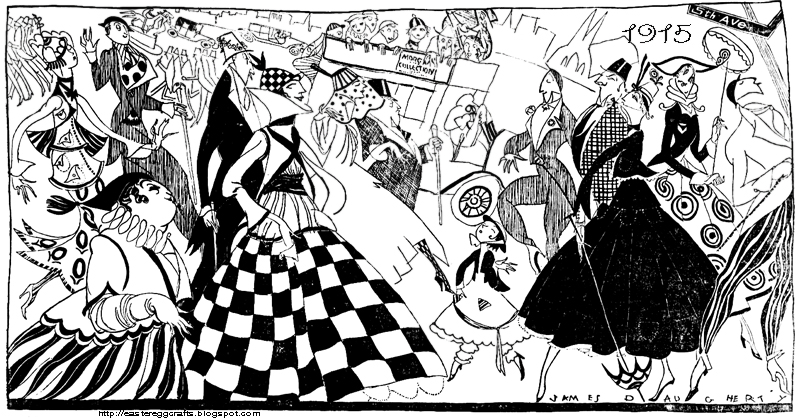
    Futuristic Fashions Parade Easter Morning

    Illustration by James Henry Daugherty from a newspaper published in 1915.

          James Henry Daugherty (June 1, 1889 Asheville, North Carolina – February 21, 1974) was an American modernist painter, muralist, children's book author, and illustrator.
          He lived in Indiana, Ohio, and at the age of 9 he moved to Washington, D.C., where he studied at the Corcoran School of Art. Later, he went to London and studied under Frank Brangwyn. During World War I, he was commissioned to produce propaganda posters for various US Government agencies, including the United States Shipping Board.
          Daugherty wrote and illustrated several children's books during his career. In his book Daniel Boone won the Newbery Medal. His book with Benjamin Elkin, Gillespie and the Guards, won the Caldecott Honor in 1957. He was also the author of Walt Whitman's America Selections and Drawings by James Daugherty.
          In September 2006, controversy erupted at Hamilton Avenue School, an elementary school in Greenwich, Connecticut, over Daugherty's depiction of Bunker Hill hero and Connecticut native Israel Putnam in a mural commissioned by Public Works of Art Project for the town hall, and installed in the school in 1935. The mural was restored, and revealed a scene, filled with violent and richly-colored imagery, including snarling animals, tomahawk-wielding American Indians, and a half-naked General Putnam strapped to a burning stake. School officials objected to the violent imagery, and ordered the mural removed to the Greenwich Public Library.
          Daugherty will be included in the exhibition The Société Anonyme: Modernism for America at the Yale Gallery in 2010.

    More Related Content:

    Thursday, March 14, 2013

    How You Wear Hat Key To Character?


    Read a person's character by how they were their hat.
           
    Character reading by hats is a new and interesting pastime...
    • The girl or woman who wears her hat firmly and squarely is called the girl or woman who has determination and ability to do things and does them.
    • The girl with a flabby hat set so it seems ready to blow off any minute is said to be of the butterfly variety, without aim or ambition. Hat at a dangerous angle means the wearer is liable to be fickle and to like flattery.
    • She with the bonnet tilted back on her heard, according to fans in character reading by hats, is prone to self-indulgence.
    • Then there is the secretive kind, hiding her eyes behind a curtain and pulling her hat down to her eyebrows.
    • The girl who is continually rearranging her hat and primping her hair may have a fitful mind.
    note: Now that we no longer wear hats often, people can never tell what our personalities are like by just looking at us.


    What do you think these bonnets reveal?
    from Abiana Studio

    Stuffing Easter Eggs


          I purchased these dessert shop Easter eggs shaped like ice cream cones, cupcakes and petit fours. I loved the unique shapes. However, as you can see, appearances are all that I paid for; I will need to stuff them a bit more than I thought.


          I also purchased a pack of Squinkies to stuff into the little people's Easter eggs, just for fun. Extra candy, a few toys, coins and printed scriptures will make up the contents of these eggs for my family's Easter egg hunt this year. Why not swipe of few of the Easter scriptures below and print them out for your little ones?