This design by Helen Grant includes: old-fashioned children (the boy with a hoop and girl with bonnet), birds, roses, peacocks, butterfly and cat. Find more patterns by her in the links below.
"My portion is not large indeed, But then how little do I need? For Nature's calls are few- In this the art of living lies: To want no more than my suffice, And make that little do. wrought by "
The apostle Paul divides human nature into a three-fold divisions. This language of the apostle, when rendered into English, shows no difference whatever between ''soul'' and ''spirit.'' We say for instance, that the soul of man has departed from him. We also say that the spirit of a man has departed from him. There is no distinct difference between the two; but in the original two very different kinds of thoughts, two very different modes of conception, are presented by the two English words ''soul'' and ''spirit.'' When the apostle speaks of the body, what he means is the animal life- that which we share in common with beasts, birds, and reptiles; for our life, our sensational existence, differs but little from that of the lower animals. There is the same external form, -the same material in the blood vessels, in the nerves, and in the muscular system. Nay, more than that, our appetites and instincts are alike, our lower pleasures like their lower pleasures, our lower pain like their lower pain; our life is supported by the same means, and our animal functions are almost indistinguishably the same. But, once more, the apostle speaks of what he calls the ''soul.'' What the apostle meant by what is translated ''soul‚'' is the immortal part of man-the immaterial as distinguished from the material; those powers, in fact, which man has by nature-powers natural, which are yet to survive the grave. There is a distinction made in Scripture by our Lord between these two things. ''Fear not,'' says He, ''them who can kill the body; but rather fear Him who can destroy both body and soul in hell.'' We have, again, to observe, respecting this, that what the apostle called the ''soul‚'' is not simply distinguishable from the body, but also from the spirit. By the soul the apostle means our powers natural- the powers which we have by nature. Herein is the soul distinguishable from the spirit. In the Epistle to the Corinthians we read, ''But the natural man receiveth not the things of the Spirit of God: for they are foolishness unto him; neither can he know them, because they are spiritually discerned. But he that is spiritual judgeth all things.'' Observe, there is a distinction drawn between the natural man and the spiritual. What is there translated ''natural‚'' is derived from precisely the same word as that which is here translated ''soul.'' So that we may read, just as correctly, ''The man under the dominion of the soul receiveth not the things of the Spirit of God; for they are foolishness unto him; neither can he know them, because they are spiritually discerned. But he that is spiritual judgeth all things.'' And again, the apostle, in the same Epistle to the Corinthians, writes: ''That is not first which is spiritual, but that which is natural;'' that is, the endowments of the soul precede the endowments of the spirit. You have the same truth in other places. The powers that belong to the spirit were not the first developed; but the powers which belong to the soul, that is, the power of nature. Again, in the same chapter, reference is made to the natural and spiritual body. ''There is a natural body, and there is a spiritual body.'' Literally, there is a body governed by the soul, that is, powers natural; and there is a body governed by the Spirit, that is, higher nature. Let, then, this be borne in mind, that what the apostle calls ''soul'' is the same as that which he calls, in another place, the ''natural man.'' These powers are divisible into two branches-the intellectual powers and the moral sense. The intellectual powers man has by nature. Man need not be regenerated in order to possess the power of reasoning, or in order to invent. The intellectual powers belong to what the apostle calls the ''soul.'' The moral sense distinguishes between right and wrong. The apostle tells us, in the Epistle to the Romans, that the heathen-manifestly natural men-had the law ''work of the written in their hearts; their conscience also bearing witness.'' The third division of which the apostle speaks he calls the ''spirit;'' and by the spirit he means that life in man which, in his natural state, is in such an embryo condition that it can scarcely be said to exist at all,-that which is called out into power and vitality by regeneration, the perfections of the powers of human nature. And you will observe that it is not merely the instinctive life, nor the intellectual life, nor the moral life, but it is principally our nobler affections,-that existence, that state of being, which we call love. That is the department of human nature which the apostle calls the spirit; and accordingly, when the Spirit of God was given on the day of Pentecost, you will remember that another power of man was called out, differing from what he was before. That Spirit granted on the day of Pentecost did subordinate to Himself, and was intended to subordinate to Himself, the will, the understanding, and the affection of man; but you often find these spiritual powers were distinguished from the natural powers, and existed without them. So, in the highest state of religious life, we are told, men prayed in the spirit. Till the spirit has subordinated the understanding, the gift of God is not complete‚-has not done its work. It is abundantly evident that a new life was called out. It was not merely the sharpening of the intellectual powers; it was calling out powers of aspiration and love to God; those affections which have in them something boundless,-that are not limited to this earth, but seek their completion in the mind of God Himself
"Where The Spirit Of The Lord Is" from Life.Church
I received this crocheted cross many years ago as a gift. It was made by an elderly lady who was bedridden near the end of her life. She could pray, sleep, eat a little and crochet. If you would like to learn how to make one just like it or similar... follow the links below to several crafters at YouTube.
From death, Christ on the Sabbath morn, A conqueror arose; And when each Sabbath dawn is born For death a healing grows. This day proclaims an ended strife, And Christ's benign and holy life.
By countless lips the wondrous tale Is told throughout the earth; Ye that have ears to hear, oh, hail That tale with sacred mirth! Awake, my soul, rise from the dead, See life's grand light around thee shed.
Death trembles each sweet Sabbath hour, Death's brother. Darkness, quakes; Christ's word speaks with divinest power, Christ's truth its silence breaks; They vanquish with their valiant breath The reign of darkness and of death.
Learn to make a very sophisticated Easter basket using textured and unusual yarns. This is a perfect Easter craft for using left over yarns that you may have tucked away in the drawer full of discards. I have so many supplies like this! I just hate to be wasteful and not use them somehow... The supplies you will need include: chenille stems (all white), yarn, cardboard, small nail and wire clippers. I made this basket for 2019, but I'm just now getting around to posting it here, sorry.
Selecting the yarn for this craft will greatly determine how your finished piece looks!
Step-by-Step Instructions:
Cut an oval from heavy cardboard for the bottom of your chenille stem basket.
Use a nail to punch holes along the outer edges of the cardboard bottom.
Bend the ends of each chenille stem around and up through the holes. The length of these fuzzy wires will predetermine the height of the sides of your basket.
At this point you may wish to wire the bottom of your basket with an extra wire or chenille stem if you intend to display it on an Easter egg tree. To wire the bottom push a stem up through and back down into two holes strategically located in the bottom cardboard.
Now continue to weave yarn in and out of every other chenille stem. The yarn you choose to use for this weave will greatly shape and affect the appearance of the basket; so choose carefully.
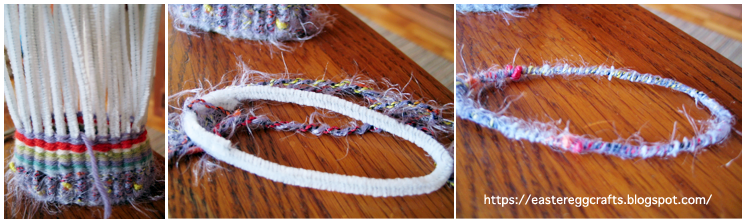
Shape a wire oval the same size of the base to twist the tips of the chenille stems around at the top of your basket.
Weave additional yarn around the top edge to cover the top edge till smooth.
Wire loops at both ends of the basket using covered wires.
Bend another wire for the handle and twist this through the wire loops at both ends to shape the basket handle.
Cover the basket handle with more yarn.
Left, Cut an oval from heavy cardboard for the bottom of your chenille stem basket. Center, Use a nail to punch holes along the outer edges of the cardboard bottom. Right, Bend the ends of each chenille stem around and up through the holes. The length of these fuzzy wires will predetermine the height of the sides of your basket.
Left, The wires inserted into each nail hole. Right, see what the bottom looks like.
Left, I decided to glue a second layer of cardboard on the bottom of my basket to make it stronger. Center, At this point you may wish to wire the bottom of your basket with an extra wire or chenille stem if you intend to display it on an Easter egg tree. To wire the bottom push a stem up through and back down into two holes strategically located in the bottom cardboard. Right, Now continue to weave yarn in and out of every other chenille stem. The yarn you choose to use for this weave will greatly shape and affect the appearance of the basket; so choose carefully.
Left, I chose to switch out my yarn types to make a stripe. Center, the bent oval stem for the top edge of my basket is the same size as the cardboard bottom, however, you could adjust this to be larger or smaller to change the shape of your basket. Right, I covered this with yarn before and after attaching it.