Saturday, February 12, 2022

Sabbath Morn by Nicolai Grundtvig

Waiting at the empty tomb...

 FROM THE DANISH OF NICOLAI GRUNDTVIG

From death, Christ on the Sabbath morn,
A conqueror arose;
And when each Sabbath dawn is born
For death a healing grows.
This day proclaims an ended strife,
And Christ's benign and holy life.

By countless lips the wondrous tale
Is told throughout the earth;
Ye that have ears to hear, oh, hail
That tale with sacred mirth!
Awake, my soul, rise from the dead,
See life's grand light around thee shed.

Death trembles each sweet Sabbath hour,
Death's brother. Darkness, quakes;
Christ's word speaks with divinest power,
Christ's truth its silence breaks;
They vanquish with their valiant breath
The reign of darkness and of death.

Monday, February 7, 2022

Weave a Chenille Stem Easter Basket

The finished yarn and chenille stem basket.

       Learn to make a very sophisticated Easter basket using textured and unusual yarns. This is a perfect Easter craft for using left over yarns that you may have tucked away in the drawer full of discards. I have so many supplies like this! I just hate to be wasteful and not use them somehow... The supplies you will need include: chenille stems (all white), yarn, cardboard, small nail and wire clippers. I made this basket for 2019, but I'm just now getting around to posting it here, sorry.
Selecting the yarn for this craft will greatly
determine how your finished piece looks!
Step-by-Step Instructions:
  1. Cut an oval from heavy cardboard for the bottom of your chenille stem basket.
  2. Use a nail to punch holes along the outer edges of the cardboard bottom.
  3. Bend the ends of each chenille stem around and up through the holes. The length of these fuzzy wires will predetermine the height of the sides of your basket.
  4. At this point you may wish to wire the bottom of your basket with an extra wire or chenille stem if you intend to display it on an Easter egg tree. To wire the bottom push a stem up through and back down into two holes strategically located in the bottom cardboard.
  5. Now continue to weave yarn in and out of every other chenille stem. The yarn you choose to use for this weave will greatly shape and affect the appearance of the basket; so choose carefully.
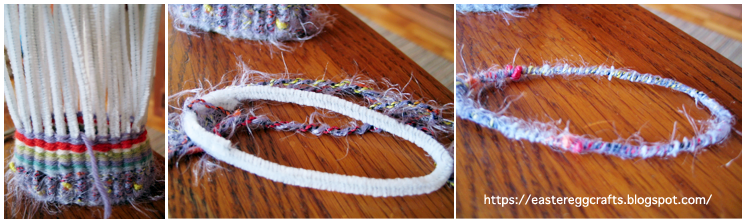
  6. Shape a wire oval the same size of the base to twist the tips of the chenille stems around at the top of your basket. 
  7. Weave additional yarn around the top edge to cover the top edge till smooth. 
  8. Wire loops at both ends of the basket using covered wires.
  9. Bend another wire for the handle and twist this through the wire loops at both ends to shape the basket handle. 
  10. Cover the basket handle with more yarn.
Left, Cut an oval from heavy cardboard for the bottom of your chenille stem basket.
Center, Use a nail to punch holes along the outer edges of the cardboard bottom.
Right, Bend the ends of each chenille stem around and up through the holes. The
length of these fuzzy wires will predetermine the height of the sides of your basket.

Left, The wires inserted into each nail hole. Right, see what the bottom looks like.

Left, I decided to glue a second layer of cardboard on the bottom of my basket to make it stronger.
Center, At this point you may wish to wire the bottom of your basket with an extra wire or chenille
stem if you intend to display it on an Easter egg tree. To wire the bottom push a stem up through
and back down into two holes strategically located in the bottom cardboard. Right, 
Now continue
 to weave yarn in and out of every other chenille stem. The yarn you choose to use for this
weave will greatly shape and affect the appearance of the basket; so choose carefully.

Left, I chose to switch out my yarn types to make a stripe. Center, the bent oval stem for the top
edge of my basket is the same size as the cardboard bottom, however, you could adjust this to be
larger or smaller to change the shape of your basket. Right, I covered this with yarn before and 
after attaching it.

Thursday, February 3, 2022

Print, Cut and Color a Vintage Rocking Bunny

Directions for Making This Vintage Easter Toy: Paste the cutout on cardboard. When the paste is dry, cut around the outline of the rocking bunny toy. When the toy has been cut out, bend it back along the dotted line in the middle, between the ears. Color the toy. Cut out the flaps and bend these at the lines. Paste the two braces at either end of the rockers between the two bunnies on the inside of the toy. Now you have a fun rocking bunny for your Easter table top!


Thursday, June 3, 2021

Simple Cross Stitch Patterns for Baby

       The historical Cross stitch patterns illustrated below are very suitable for decorating articles which belong to young children; for instance, the row of pigs could be embroidered on a bib, or, with the addition of some other animals, might form a border that could be applied to a nursery table cover or curtain.
      A rabbit sitting between two plants might be used just as they are for decorating some small article, or they could be repeated to form a border design, and in that case other animals might be introduced as well as the rabbit.
      The two borders and the flower sprigs could be embroidered on any article for which cross stitch is a suitable decoration. The sprigs could be adapted to a collar design, repeated to form a border, or used as an all-over spot pattern. Any plant with a definite outline can be translated into cross stitch, and if it were small enough, could be added to these designs to decorate a spring themed baby quilt, a small sampler to hang in a nursery or to hand stitch a few decorative pillows for a rocker located in the cozy corner of the baby's nursery.

cross stitch of bunny, flowers, pigs

Monday, February 22, 2021

Color these fancy "egg heads" for Easter!

Fancy "egg heads"

Description of Coloring Page: Egg heads include a traditional Dutch girl in costume, a pirate, a mysterious magician and an egg decorated with springtime flowers. 

Don't forget to drag the png. or jpg into a Word Document and enlarge the image as much as possible before printing it folks. If you have a question about this coloring page, just type into the comment box located directly below this post and I'll try to get back to you as soon as I can.

Wednesday, March 18, 2020

Easter Games by Lina Beard, 1905

Prize winner with his Easter basket
on the White House lawn, 1923.

       In the game they play at Washington, on the hills sloping from the White House, the child whose egg reaches the foot of the hill in an unbroken condition takes the one worsted in the journey down. Another game for two is played by knocking the eggs together ; each child holds an egg firmly in his hand so that only the small end is visible, and then the two eggs are struck against each other until one is cracked, when the victorious player adds it to his stock, or devours it on the spot. I would not like to state the number of eggs eaten on these occasions, but there is a boy (not a girl) who once consumed fourteen and lived to tell the tale.
       Sometimes the egg which breaks another is called "the cock of one," and when it has broken two it is " cock of two," and so on. When an egg which is cock of one or more is broken, the number of trophies won by the victim is added to the score of the conquering egg and it becomes " cock of three " or more. Here is a game which comes from Germany, and al- though in that country it is played exclusively by boys, there is no reason why the girls should not participate in it as well. Two baskets are necessary for this game, one large and shallow filled with soft shavings, the other shallow also, but smaller, and filled with eggs. The plan of the game is that one player is to run a given distance, while another safely throws the eggs from one basket to the other, she who completes her task first being the winner. When the baskets are prepared, and the distance the eggs are to be thrown decided upon, the two contestants draw lots to determine who shall run and who shall throw. This settled, the player who throws takes the basket of eggs, and one after another quickly tosses them the length of the course and into the basket of shavings, which is placed on the ground at the end of the course opposite the thrower. In Germany this basket is held by an assistant, but anyone occupying that position might receive some severe blows from the hard eggs thrown by unpracticed hands, and it answers the purpose just as well to place the basket on the ground. Meantime the other player runs the distance (decided beforehand) to an appointed goal, marks it as a proof of having touched it, and should she succeed in returning before all the eggs are thrown, the victory and prize are her reward; otherwise they belong to the thrower.
       The game finished, a prize is presented to the successful contestant. Should any of the eggs pitched by the thrower fail to light in the basket, they must be gathered up and thrown again before the runner returns, as the eggs must all be in the basket before the thrower wins the game.
       "Bunching eggs " comes from Ireland, and is played in very much the same manner as the game played with a slate and pencil, and known to all children as " tit, tat, toe, three in a row." A pan or large dish filled with sand or sawdust is set upon a table, around which the children stand, each supplied with eggs; the eggs of each player must be all of one color, and unlike those of any other player. The object of the game is for each player to so place her eggs, standing them upright in the sand, or sawdust, as to bring five in a row touching each other.
       In turn each player puts down an egg, sometimes filling out a row for herself, at others cutting off the line of an opponent; and the one who first succeeds in obtaining the desired row sings out--

"The raven, chough, and crow,
Say five in a row."

       Another pretty game from Ireland called " Touch " is played in the following manner:
       Six eggs of the different colors green, red, black, blue, white, and gold are placed in a row in the sand used for the other game. One of the players is blindfolded and given alight wand or stick, with which she must touch one of the eggs, while at the same time she recites these lines:

Peggy, Patrick, Mike, and Meg,
See me touch my Easter egg ;
Green, and red, and black, and blue,
Count for six, five, four, and two.
If I touch an egg of white,
A forfeit then will be your right ;
If I touch an egg of gold,
It is mine to have and hold.

       As is told in the rhyme, the eggs each have a different value. Green counts six ; red, five ; black, four; and blue, two ; and the gold egg is worth more than all put together, for when a player touches that, she wins the game and a forfeit of. an egg from each of the other players. The white egg is worth less than nothing, since it not only has no value but whoever touches it with the wand must pay a forfeit.
       Each player is in turn blindfolded and makes her trial, keeping account of the value of the eggs she has touched. When the sum of twenty has been reached by anyone the game is ended, without the aid of the gold egg. The position of the eggs are changed after each trial, that the person about to touch them may not know where it is best to place her wand.